|
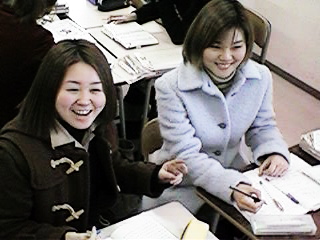 Expectations Run High at
the Kentan Expectations Run High at
the Kentan
 Many
students have a clear idea about why they entered the Kentan. But are
the actual classes meeting their hopes, and how do teachers feel
about students? Many
students have a clear idea about why they entered the Kentan. But are
the actual classes meeting their hopes, and how do teachers feel
about students?
What Students Want
Students hope teachers have good personalities, knowledge and skill.
They want teachers to be friendly, have a sense of humor, knowledge
of various matters, correct pronunciation, and be good at explaining.
These characteristics draw out the potential of students.
Students want to have classes where they can participate actively.
They are eager to state their opinions and discuss, rather than have
a class where the teacher does all the talking and students all the
listening.
What Teachers Want
Teachers have different impressions of Kentan girls. They wish they
would be more flexible, more ambitious and more positive. They hope
students will have an international view to get along with people all
over the world. They should be flexible, yet have their own
principles. Some teachers praise Kentan students for being obedient,
although students may rebel on occasion. Teachers hope students
should have a wide view and make the most of opportunities they're
given. They hope that students can tap their knowledge. And teachers
hope students will be positive, expressing their ideas freely.
Each teacher has their own ideas about class. They want classes that
are easy for students to understand, where they can think flexibly
and feel the pleasure of learning. Teachers often think about their
classes and students, and hope that both can improve.
Both students and teachers have their own ideas about classes and
each other. If they share their ideas with one another, the Kentan
experience can improve for everyone.
|
|
 Japanese Give Place to
English Japanese Give Place to
English
If we
are asked, "Can you speak English?", most people can never say "yes"
definitely. But the popularity of learning English is now on the rise
and the government promotes English education in Japan.
Generally, English is a common language among Japanese. That is,
every junior high school student must study it. And the Ministry of
Education has decided that Japanese should begin studying it from
elementary school. Since they also have to study Chinese characters,
this puts a lot of pressure on elementary school children.
Likewise, many people doubt that the "examination English" that
Japanese learn in order to enter high school and college is useful.
Examination English includes vocabulary and grammar, but not
listening and conversation much. This is due to the nature of the
entrance exams being prepared for. So it is natural that students can
not have confidence in their English.
If a foreigner asked directions from a Kentan English major, most
think they would be able to help them in English. Some might try
using Japanese first, but would then use English if necessary.
In the media, there is a tendency to use English. You can find many
English words when you are reading newspapers, watching a news
program on TV, and so on. They are called "loanwords." Although these
words are sometimes difficult to understand, Japanese often use them.
In fact, nine percent of Japanese words originate from English.
Now Japanese mix Japanese words up with English ones. If people use
loanwords so freely, what will happen to Japanese? Of course it's
good to study English and students can increase their joy of life
through it. But they should be careful not to loose they identity in
exchange for English.
|
|
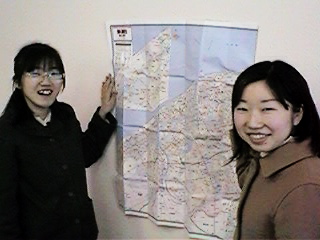 School Location Limits
Students' Lives School Location Limits
Students' Lives
Although many Kentan students enjoy their school life,
but are inconvenienced by the school's location. These discontents
focus on transportation, safety and personal relationships.
Transportation
Many students come to school by car or bus, but the students who come
by train have the most complaints. Although trains and cheap and
simple, they are too few . Furthermore, it takes 15 minutes to walk
from Ogata Station to the school. And that road is very bad because
of the strong win that blows across the rice fields. Moreover, there
are no lights, so the street isn't safe.
Safety
It is not safe around the Kentan, according to many students. That's
because there are few buildings are the campus, especially on the way
to Ogata Station. And some students have had frightening experiences.
Students report being approached or even touched by strangers.
Unfortunately, there is not a police station near Ogata Station.
"No Chance"
Students feel they do not have a chance to socialize near campus
because of the location. There are only restaurants near the Kentan,
and one has to walk a distance to find any shops. And if you get a
part-time job near the Kentan, your coworkers will only be fellow
Kentan students. Students yearn to meet other young people at clubs,
parties and so on. But to do this, they have to travel into the
city.
Thus there are many problems about the Kentan's location. Yet
students are confused about the ideal location -- should it be
convenient like a location in downtown, or safe like in the suburbs?
But since the location can not change easily, students must do the
best they can.
|